Why Retrieval Practice Begins with a Pause
Retrieval practice makes review more active: use a small, low-pressure prompt before reopening your notes, then check what you remembered.
The common mistake with retrieval practice is to make the pause feel like an exam: close the notes, demand a complete answer, then judge yourself for what is missing. That turns a useful moment of recall into a test of nerve. Retrieval practice works more gently when you ask for one small idea before looking back, giving memory a chance to do some work without making the session a performance.
The pause matters because rereading shows an idea to you, while retrieval asks you to bring it to mind. Those are different actions. A short attempt can reveal what is readily available, what is hazy and what deserves another look. It need not be polished, complete or even correct to be useful. The point is to make an honest attempt, then compare it with a reliable source.
Choose one small target
Begin by choosing a single piece of material to review. It might be a paragraph from a biology text, a concept from a lecture, a procedure in a language lesson or a definition in a set of notes. Keep the target narrow enough that you can name it in a sentence. “Explain the entire chapter” is not a target; it is a request for a new chapter.
Pick a question that asks for the central idea, a relationship or one useful detail. For example:
- What does this term mean in plain language?
- Why does this step happen before the next one?
- What is one difference between these two ideas?
- What example would help me recognise this concept?
A prompt should point your attention without giving away the answer. “What is the definition of osmosis?” is workable if the term is what you are studying. A question that reproduces the whole definition in a hint is less helpful: it has already done the remembering for you.
If the source is a long chapter, choose a heading or a small section rather than trying to retrieve every point at once. If it is a diagram, select one labelled part or one connection between parts. Small prompts make it easier to notice exactly where your recall becomes uncertain, instead of leaving you with the vague impression that you remember “some of it”.
Set a low-pressure pause
Put the source out of sight for a moment. Close the book, turn over the worksheet or minimise the notes. Then allow yourself a brief pause to think. There is no need to set a strict timer. The pause is long enough for a genuine attempt and short enough that you do not turn the exercise into a staring contest.
Try to retrieve just the part named by the prompt. Say it quietly, write a few words, draw a rough relation or sketch a simple sequence. Choose the format that suits the material. A definition may call for a sentence; a process may be easier to sketch with arrows. Spelling, phrasing and presentation are not the point at this stage.
Keep the stakes modest. You are gathering a clue about what is available in memory, not issuing a verdict on your ability. If nothing comes to mind, make the smallest attempt you can: recall a related word, name the topic, or say what part of the question feels familiar. Then look back. The pause has still served its purpose by showing that the prompt needs more support or a smaller scope.
It can help to make the prompt private and temporary. A scrap of paper, the margin of your notebook or a note on your screen will do. You do not need a formal score, a colour-coded tracker or a perfectly kept retrieval journal. Those things can become another task to maintain, which is an elaborate way of avoiding the actual pause.
Record a rough answer
Make a small record of what you can recall before checking. Use keywords, a quick sketch or a short spoken answer. Do not improve it by peeking at the source halfway through. The roughness is informative: it preserves the difference between what came to mind unaided and what you recognised once you saw it again.
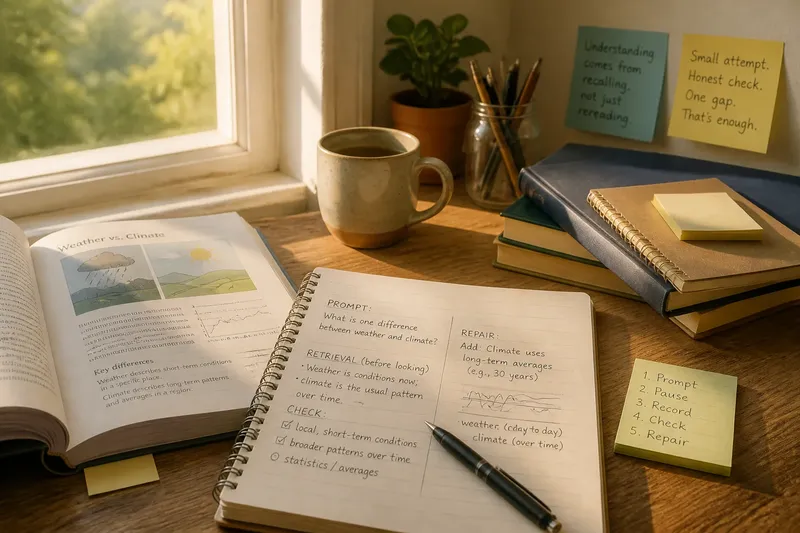
Imagine you are reviewing a note on the difference between weather and climate. You close the note and write, “Weather is conditions now; climate is the usual pattern over time.” Then you reopen the material and check whether it also distinguishes local, short-term conditions from broader patterns. The brief answer has recalled the main contrast; the comparison shows what needs sharpening. There is no need to rewrite the whole note.
If you are studying with another person, take turns asking one prompt and listening to the other person’s short answer. Keep the prompt specific and avoid turning the exchange into a quiz show. The listener can ask, “What part are you least sure about?” before opening the source. That invites a useful admission of uncertainty without demanding a confident-sounding answer.
For solo study, a voice memo can be useful when writing would slow you down, especially for language learning or explanations you need to say aloud. Keep it brief, then check the relevant passage. Long recordings are rarely a kindness to your future self, who may have to listen to them.
Check against the source
Now reopen the notes, textbook or prepared answer. Compare your attempt with the source for meaning, not identical wording. Look for the central relationship, the distinguishing feature or the detail that changes the answer. A different phrase can be perfectly sound; a missing connection may matter more than a missed adjective.
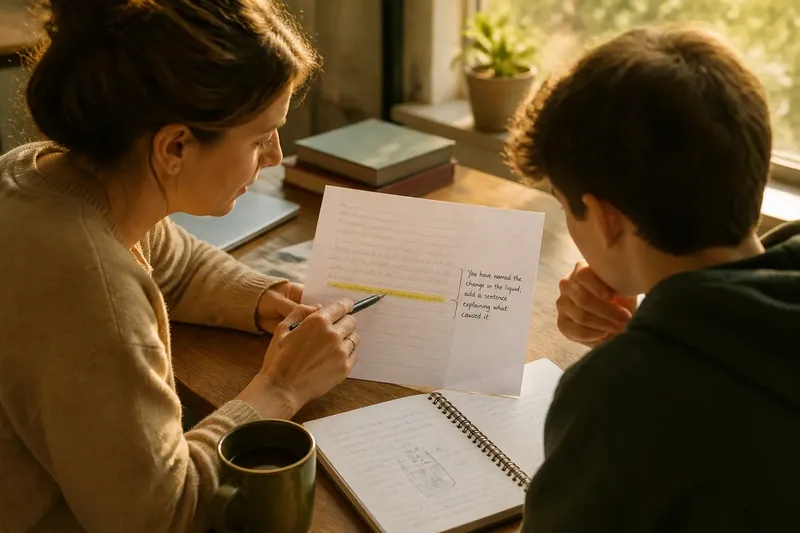
Make the comparison active. Instead of reading the whole page again, locate the part that answers your prompt. Mark what you recalled correctly, what was incomplete and what was mistaken. A simple pencil mark beside the missed point is enough. If you keep a digital notebook, add a short correction next to the original prompt rather than copying a whole passage into another file.
Be careful not to treat familiarity as recall. The answer may look obvious once it is in front of you. That feeling does not mean it was available before you looked. Keep your original attempt visible while checking so you can see the difference between what you produced and what the source supplied.
Where an answer depends on a particular course definition, notation or teacher’s convention, use the version required by that course. For specialist or high-stakes material, check against an authoritative learning source or ask a qualified instructor rather than relying on a half-remembered note.
Repair one gap
After checking, choose one point to repair. You might add a missing phrase to your answer, redraw a connection, or write a smaller prompt for the part that remained unclear. Avoid turning the correction into a full set of rewritten notes. The purpose is to make the next attempt better informed, not to decorate the same information until it looks busy.
A useful correction is specific. “Review chapter three” does not say what needs attention. “Explain why the second stage follows the first” gives you a prompt you can try again. If your answer was mostly right but lacked a boundary or exception, make that distinction the next target. If you could not begin, break the original prompt into a smaller question that asks for a name, a link or a first step.
Then return to the source briefly and make sure the correction is clear. Close it again and try the revised prompt once, if the point is now understandable. If it still will not come, leave the source open long enough to learn the relationship before asking memory to reproduce it. Retrieval practice is not a requirement to struggle indefinitely.
The amount of repair should fit the size of the gap. A missing label may need a glance; a confused concept may need a fresh explanation, an example or help from a teacher. Rereading can be useful for that first understanding. The distinction is not between good retrieval and bad rereading, but between using each action for the job it can do.
Choose a later return
Once the prompt is clear, decide when it would be useful to try it again. A later return gives you another chance to bring the idea to mind without the source immediately beside it. The timing can depend on the material, your course schedule and how secure the idea feels. You do not need a universal timetable or an elaborate calendar to make another attempt.
Write the prompt where you will encounter it during ordinary study: on a blank side of a flashcard, in a short list of review questions or beside the section heading in your notes. Keep the answer hidden until you have attempted it. A card with one question on the front and a concise answer on the back can work well, provided the question is genuinely small and the answer is not a page of prose.
When the prompt returns, use the same sequence: attempt, check, repair. If the answer comes readily and matches the source, move on rather than repeating it for the comfort of repetition. If a detail is missing, revise the prompt or the answer so the next return tests that detail. If you are unsure whether the prompt is too broad, see whether you can answer one clear part without reopening several pages.
Do not make a missed answer into a score that follows you around. A prompt is a tool for deciding what to review, not a measurement of your worth or potential. If a session is tiring, reduce the number of prompts or stop and return later. Low pressure is not a decorative mood; it is part of keeping the attempt honest.
Questions about the pause?
How long should I pause before looking?
Pause long enough to make a real attempt, but not so long that you are stranded. If the answer is not coming, offer a related word or identify the part you cannot recall, then check the source.
What if I remember nothing?
Make the prompt smaller or use a cue that names the topic without revealing the answer. A blank attempt is information about what needs support, not a reason to keep guessing.
Is writing better than saying an answer aloud?
Neither is universally better. Write when the material depends on precise terms or relationships; speak when fluency, explanation or pronunciation matters, and use a sketch for spatial connections.
Should I reread after every attempt?
Check the relevant source after an attempt so you can correct errors and notice omissions. You can then stop if the answer is clear, rather than rereading the entire section by habit.
Keep the effort useful
Retrieval practice begins with a pause, but the pause is only one part of a sound review. A narrow prompt makes an attempt manageable; a rough answer shows what came to mind; a focused check identifies one useful correction. This is enough structure for an ordinary study session, whether the material sits in a printed textbook, a lecture handout or a set of digital notes.
Not worth the effort: building a complicated scoring system for every small question, or polishing each response until it resembles the source. Those habits add administration without making the pause more revealing. Keep the prompt small, give memory a moment to answer, then use the source to decide what to do next.