Worked Example or Open-Ended Task? Choosing a Starting Point
Worked example or open-ended task: choose the right starting point for a new topic, so learners spend effort on the intended skill rather than guessing the basics.
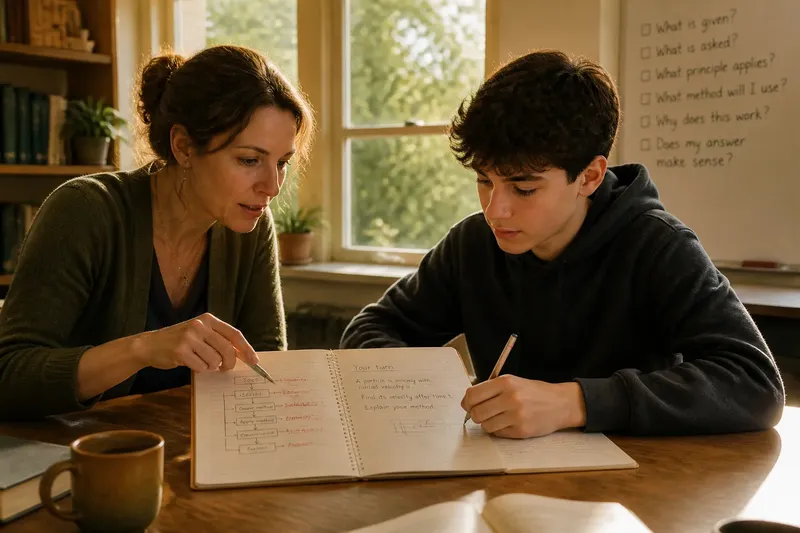
The common mistake with a new topic is to begin by asking learners to solve a problem before they know what a sound solution looks like. An open-ended task can then become an exercise in guessing the teacher’s expectations, not learning the subject. A worked example or open-ended task is a choice about how much structure to provide at the start, and that choice determines where a learner’s effort goes.
A worked example makes the route visible: it shows a problem, the decisions made and the resulting answer. An open-ended task leaves more of those decisions to the learner. Neither is automatically more rigorous. The useful question is whether a learner already has enough knowledge to make productive choices, rather than merely enough confidence to start.
What structure changes
Structure is not the same as difficulty. A problem can be intellectually demanding while still giving learners a clear first move. Conversely, a task with a simple-looking outcome may be difficult because it leaves the goal, method or criteria unclear.
A fully modelled example can make several parts of a new topic explicit:
- The starting information: what is given and what matters.
- The method: which operation, principle or decision is used next.
- The reasoning: why that move fits, rather than simply what to write.
- The result: what a plausible answer or finished product looks like.
An open task transfers some or all of these choices to the learner. That transfer can be useful when learners have the concepts and tools needed to make sensible decisions. It can be wasteful when they are still trying to infer the vocabulary, conventions and basic sequence of the topic.
For a teacher, the choice is not between explaining everything and leaving learners alone. It is a decision about where to place the boundary: which parts to model, which parts to leave for practice, and when to move that boundary.
Start with the unfamiliar part
Before choosing a format, identify what is genuinely new. A learner may already know how to organise an answer but not how to select evidence. Or they may understand the underlying concept but be unfamiliar with a notation system. The starting task should support the unfamiliar part without unnecessarily modelling skills the learner can already use.
For a new topic, a fully worked example is often the clearer beginning when several unfamiliar decisions must be coordinated. It prevents the learner having to invent a method while also trying to understand what the task means. A more open start can fit when learners already have relevant knowledge, the prompt itself is clear and there are several reasonable routes to an answer.
Look for signs that the difficulty comes from missing structure rather than from the intended learning:
- Learners ask what the question means before they can engage with its subject.
- They produce unrelated attempts because the expected form is invisible.
- They make several basic decisions at once and cannot explain any of them.
- They copy a visible format without being able to explain why its parts belong there.
The last sign matters. A model can become decoration if it shows a finished product but hides the decisions that produced it. Explain the choices in the example. A model answer without its reasoning is a photograph of a staircase with no stairs attached.
A week of fading support
For a new topic introduced over a week, support can be reduced in deliberate stages. The schedule below is a flexible pattern, not a rule about how quickly learners must progress. Keep a stage in place longer if learners still need its support; move on when they can explain the relevant decisions, not merely reproduce the layout.
First session: show the route
Introduce one fully worked example. Choose a representative problem rather than an unusual puzzle, and make the reasoning visible alongside each move. Mark the point where a choice is made, explain what information informs it, and connect the result back to the task’s goal.
Keep the first example focused. If it contains several new conventions, distracting details or optional methods, learners have to work out which features are essential. A clean example gives them a usable reference point without pretending that every later problem will look identical.
Second session: complete a near match
Set a closely related task with the same underlying structure but different content. Provide the opening move or a partly completed solution, then ask learners to finish the remaining decisions. The close match makes it easier to notice whether they understand the method or have only remembered the example’s surface details.
Invite learners to name the decision they are making as they work. A brief note in the margin, a spoken explanation or a line beside the solution can reveal whether they know why the next move fits. This is not a request for an essay about every mark on the page; it is a way to make the reasoning inspectable.
Third session: remove one support
Give a new task with the same central principle, but remove one scaffold. If the earlier example supplied a first step, leave that step to the learner. If it named the relevant principle, ask the learner to identify it. Avoid removing the goal, the method and the success criteria all at once; that changes the exercise from practice into a guessing game.
Compare solutions against the reasoning in the original model. Ask which choice transfers and which details belong only to the original problem. This helps learners separate a reusable method from an incidental feature, such as a particular number, phrase or layout.
Fourth session: choose a method
Offer a task with more than one plausible route, or ask learners to select which method suits a new problem. They now have a reason to make a choice, rather than simply follow the most recently displayed pattern. Provide criteria for a sound response, such as accurate reasoning and a result that addresses the prompt, without prescribing every move.
At this point, learners may benefit from comparing different valid approaches. Ask what each approach makes easy to see, where it requires care, and how the problem’s features support the choice. The purpose is not to declare one method universally superior; it is to build judgement about when each method fits.
Fifth session: open the task
Set a genuinely open task only if the earlier sessions have supplied the knowledge needed to begin. State the purpose and any necessary boundaries, then leave meaningful choices to learners. They might select evidence, decide how to organise a response or choose between methods, depending on the topic.
Review the work for the intended learning, not merely completeness. If learners can explain their choices and use the central idea accurately, the open format is serving its purpose. If most effort went into guessing the task’s expectations, restore the missing structure next time.
Choose the starting point?
When should a new topic start with a worked example?
Start with a worked example when learners face several unfamiliar decisions that must fit together. Make the reasoning visible, not just the finished answer, so the example shows a method they can adapt.
When is an open-ended task a sensible first move?
Use an open start when learners already have relevant knowledge and can understand the prompt without guessing its basic requirements. Leave room for choice, but make the purpose and boundaries clear.
How can I tell if a model is too detailed?
If learners copy its surface features but cannot explain the decisions, the model may be showing too much product and too little reasoning. Remove incidental detail and draw attention to the choices that matter.
What if learners have different starting points?
Give the same learning goal with different amounts of initial support. Some learners can begin with a partly completed example, while others use the full model; invite them to move to less support when they can justify the next decisions.
Adjust support carefully
When learners struggle, diagnose the missing piece before making the entire task easier. They may need a reminder of a prerequisite idea, a clearer prompt, a model of one decision or a more visible success criterion. Each adjustment addresses a different source of difficulty; adding all of them can obscure what learners can already do.
When learners finish easily, do not simply add more items of the same kind. Reduce one part of the support or introduce a decision the model did not settle. The aim is to increase responsibility for a useful choice, not to make the page longer. A handful of well-chosen problems can reveal more than a stack of near-identical repetitions.
It is not worth the effort to produce a model for every possible variation. That quickly turns examples into a catalogue and encourages learners to search for a matching template. One representative case, followed by a carefully chosen variation, usually gives a clearer view of what can transfer.
Say you are introducing a new way to compare two short arguments. Learners already know how to identify a claim, but they have not learnt to judge whether the supporting reasons address the same issue. Begin with a model that marks the shared question, explains which reasons answer it and shows a concise comparison. Next, give them a similar pair with the comparison frame partly supplied; after that, remove the frame and ask them to choose how to organise the reasoning. The expected observable change is that they can make and explain the comparison without relying on the original wording.
Worked example or open-ended task is therefore not a contest between hand-holding and independence. It is a decision about which choices learners are ready to make now. For a new topic, begin with enough structure to expose the method, then remove support one decision at a time. The useful test is whether learners can explain what they chose and why when the example no longer supplies the answer.